UK Boat Marking & Identification Rules Explained

UK boats are subject to a range of marking and identification requirements, and it’s not always obvious which are mandatory, which are scheme-based and which are simply good practice. The rules vary depending on the type and size of vessel and how it’s used. This guide covers the main requirements for recreational and small commercial boats.
Boat name and port of registry
Any boat registered on Part I of the UK Ship Register (the full register, managed by the Maritime and Coastguard Agency) must display its registered name and port of registry on the exterior of the hull. The name must be clearly legible. There is no prescribed minimum size for recreational vessels, but it must be readable from a reasonable distance.
Boats registered under the Small Ships Register (SSR) — the simpler, cheaper register used by most recreational sailors — are not legally required to display a name or port of registry on the hull, though most owners do so as a matter of course.
Official number and tonnage marking (ON/NT)
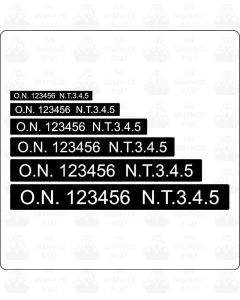
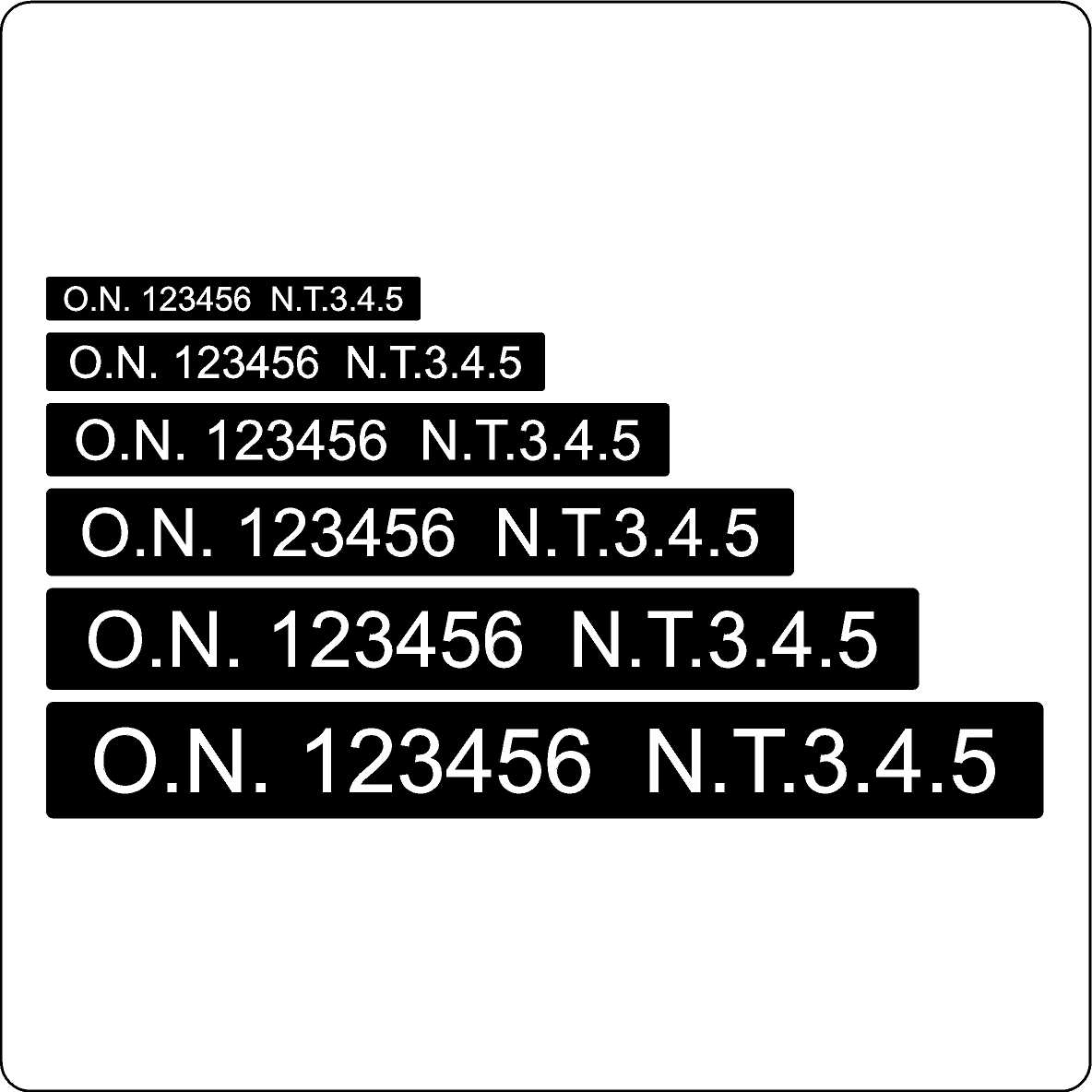
Boats registered on Part I must have their official number and net tonnage permanently marked on a main structural member of the hull — traditionally by carving, but an engraved plate affixed to the hull is accepted as equivalent. This is the “carving and marking” requirement that gives this topic its name.
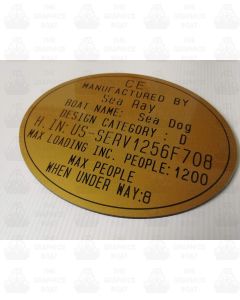
The plate must show the official number (prefixed ON) and net tonnage (prefixed NT). We supply engraved ON/NT tonnage plates and builders’ hull plates for this purpose — both are laminate plastic engraved plates that satisfy the permanent marking requirement.
SSR-registered boats do not require an ON/NT plate, but the SSR number should be marked on the hull — this is what identifies the boat if it’s recovered following theft or an incident.
Small Ships Register (SSR)
The SSR is the most common form of registration for UK recreational boats. It’s a requirement for sailing in the territorial waters of many countries (proof of nationality), and some marinas and charter companies require it. Registration involves marking the SSR number on the hull — by carving, engraving or a permanent adhesive label.
SSR numbers are formatted as SSR followed by a six-digit number. We can supply SSR number stickers cut in marine-grade vinyl if you need a straightforward solution for the hull marking requirement.
Lifebuoy marking
Lifebuoys and other lifesaving appliances should be marked with the boat’s name and port of registry (or home port). This helps search and rescue services identify the vessel if equipment is found in the water. It’s not always strictly enforced on small recreational craft, but it’s good practice and is a requirement for vessels operating commercially.
Navigation lights
All vessels underway between sunset and sunrise, or in restricted visibility, must display the appropriate navigation lights as set out in the COLREGs (International Regulations for Preventing Collisions at Sea). The specific lights required depend on the vessel’s length, propulsion type and whether it’s at anchor or underway. This isn’t a marking requirement as such, but it’s part of the same legal framework governing vessel identification at sea.
Boat Safety Scheme (BSS)
The BSS applies to boats with domestic fuel-burning appliances or fuel systems used on inland waterways in England and Wales — effectively most narrowboats and canal cruisers. A valid BSS certificate is required to use Canal & River Trust and Environment Agency waterways. Compliance is indicated by a BSS examination certificate, not by any specific hull marking.
Pleasure Craft Identification Scheme (PCIS)
The PCIS is a voluntary scheme operated by some police forces, in which a unique code is marked on the hull to assist in recovering stolen boats. Participation involves displaying the code in a prominent location — usually on the hull sides. It’s not a legal requirement but can help with insurance claims and recovery.
VHF radio licence
Any boat fitted with a marine VHF radio must hold a Ship Radio Licence issued by Ofcom. The vessel’s assigned MMSI number and callsign should be used when transmitting. The licence must be carried on board. This is an Ofcom requirement, not a hull marking requirement, but it’s part of the identification framework that applies to most equipped recreational vessels.
A note on enforcement
Many of these requirements are rarely actively enforced on small recreational craft in domestic use — but they become relevant when a boat is involved in an incident, reported stolen, or crossing international borders. Getting the marking right from the outset is straightforward and avoids complications later.
If you need engraved plates, SSR number stickers or any other identification marking for your boat, get in touch and we’ll advise on the right approach.
About the Author

Related Posts
RYA Training for Boaters: Sea and Inland Waterways
Flag Stickers for Boats, Cars & Caravans
UK Fishing Vessel PLN Marking: A Compliance Guide
Related Products