UK Fishing Vessel PLN Marking: A Compliance Guide

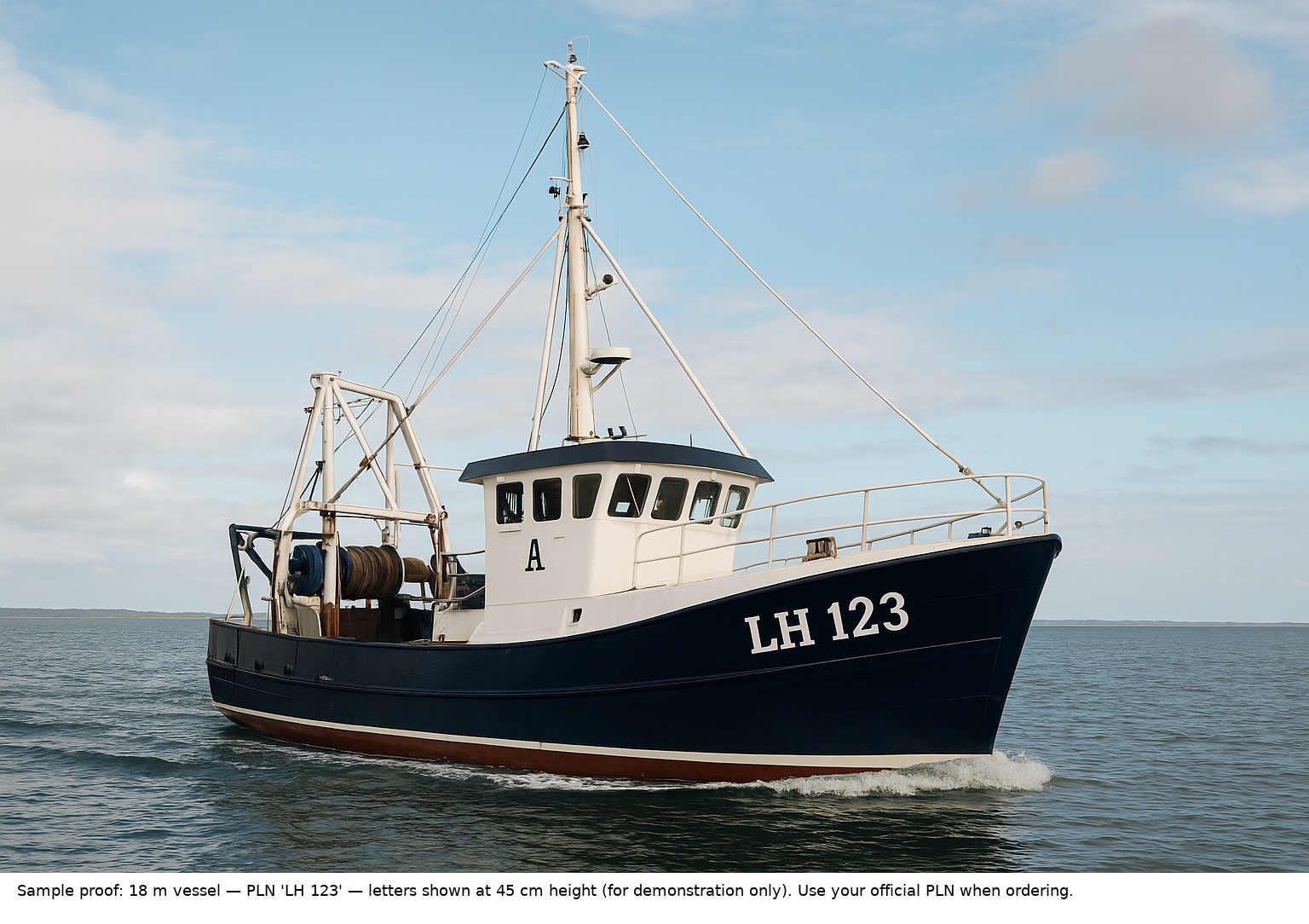
Every registered UK fishing vessel must display its Port Letters and Number (PLN) on the hull. This isn’t a convention — it’s a legal requirement under the Fishing Vessels (Marking and Identification) Regulations. The PLN is issued by the Registrar when the vessel is registered, along with a Carving & Marking note that specifies what must be marked and where. The marking must then be inspected and signed off by an authorised measurer or inspector before the vessel goes to work.
What size must the PLN letters be?
The required minimum size depends on the overall length of the vessel. For vessels not over 17 metres, port letters and numbers must be at least 25 cm high with a stroke (line) width of at least 4 cm. For vessels over 17 metres, the letters and numbers must be at least 45 cm high with a stroke width of at least 6 cm.
Measure your vessel’s overall length to determine which category applies, and use the PLN exactly as it appears on your Certificate of Registry or Carving & Marking note — not from memory and not from an online port code list. Online lists are illustrative only; your registered PLN is the only authoritative reference.
Where must the PLN be displayed?
The PLN must appear on both sides of the bow and on each quarter of the vessel, positioned as high above the waterline as practicable so the marks are visible from both sea and air. Where the vessel has a suitable horizontal surface — a wheelhouse roof or foredeck, for example — the PLN should also be marked there where practicable.
Marks must be in a colour that contrasts clearly with the background. White lettering on a dark hull and black lettering on a light hull are the standard approaches. The requirement is legibility from sea and air; poor contrast fails the inspection regardless of the letter size.
Vinyl or paint — what does the law actually allow?
The regulations require that PLN markings be “painted or displayed.” In practice, marine-grade vinyl is widely accepted as satisfying the “displayed” requirement, provided the marking is permanent and conspicuous, meets the size and contrast requirements, and is not easily effaced or obscured. Vinyl has been used on UK fishing vessels for many years without objection from surveyors, but if in any doubt, discuss it with your local MCA Marine Office before fitting.
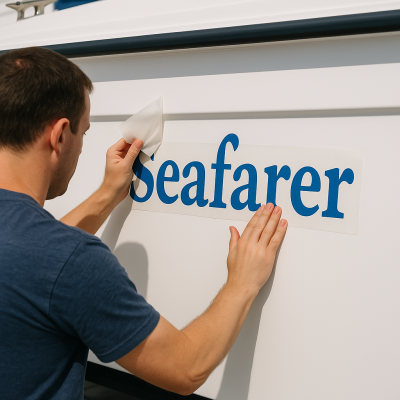
The practical advantages of vinyl over paint are consistency and replaceability. A vinyl-cut PLN at the correct letter height will have accurate, uniform stroke widths — important when the minimum stroke width is specified in the regulations. Replacing a worn or damaged set of letters is straightforward; repainting a large mark on a working hull is not.
Marking fishing gear and buoys
Passive fishing gear — pots, creels, nets and beam trawls — and the buoys and markers attached to them must be marked with the vessel’s PLN. This allows lost or abandoned gear to be identified, recovered and returned to the owner, and is increasingly important as harbour authorities and IFCAs crack down on ghost gear.
The specific requirements for gear marking can vary by area. Check with your local Inshore Fisheries and Conservation Authority (IFCA) and Harbour Authority for any byelaws that impose additional or more specific obligations. Some areas specify minimum marker buoy dimensions, colours and the size of the PLN marking on gear — these can be more demanding than the vessel marking rules.
We can supply smaller vinyl PLN labels sized and formatted to match your vessel markings, so your gear carries a consistent identifier throughout.
How to order
To order compliant PLN lettering, you need three things: the exact PLN from your Certificate of Registry or Carving & Marking note, the overall length of the vessel (to confirm which size tier applies), and the background colour of the hull where the marks will go (to choose the right contrasting vinyl colour).
Use our lettering designer to set up your PLN at the correct height — enter 250mm for vessels ≤17m, or 450mm for vessels >17m, and select a high-contrast colour. We cut and supply the lettering with fitting instructions; you’re responsible for ensuring the completed marking passes inspection, so keep your Carving & Marking note to hand during fitting.
If you’d prefer to send us the details and have us produce a proof first, get in touch and we’ll confirm the sizing and layout before anything is cut.
Common UK port letter codes
The list below is an illustrative reference only and is not an official registry. Your PLN — the only one that matters — is on your Certificate of Registry. Use this list for general familiarity only, not as a basis for marking your vessel.
A (Aberdeen), AA (Alloa), AB (Aberystwyth), AD (Ardrossan), AH (Arbroath), AR (Ayr), BD (Bideford), BE (Barnstaple), BH (Blyth), BL (Bristol), BM (Brixham), BN (Boston), BR (Bridgwater), BW (Barrow), CK (Colchester), CL (Carlisle), CN (Campbeltown), CO (Caernarfon), CS (Cowes), CT (Castletown), CY (Castlebay), E (Exeter), FH (Falmouth), FY (Fowey), GY (Grimsby), H (Hull), HE (Hayle), HH (Harwich), IH (Ipswich), LI (Littlehampton), LL (Liverpool), LN (King’s Lynn), LO (London), LT (Lowestoft), MH (Middlesbrough), NE (Newcastle), NN (Newhaven), P (Portsmouth), PE (Peterhead), WY (Whitby).
Frequently asked questions
Where do I get my PLN? The PLN is issued by the Registrar when you register the vessel. It appears on your Certificate of Registry and Carving & Marking note. You cannot choose or change it; it is assigned at
About the Author

Related Posts
RYA Training for Boaters: Sea and Inland Waterways
UK Boat Marking & Identification Rules Explained
Flag Stickers for Boats, Cars & Caravans